Tuesday, February 4, 2020

Film Studies Evaluation

Film Studies Evaluation

Throughout this unit I have analysed three different theorists and looked at how they impact cinema and help create more meaning behind scenes in films constructed with a purpose. The theorists I have looked at were: Freud and his Id, the Ego and the Superego theory, Mulvey and her male gaze theory and Lacan and his theory on Lack and Desire. Studying these theories I have discovered how they can influence the narrative and themes of films. When looking at Mulvey and Lacan i briefly looked over key scenes in transformers and the wolf of wall street making sure that i talk about the significance of the link between the theories and the text i was analysing. The theory I chose to analyse deeper was Freud's Id the Ego and the Superego theory, in doing this I looked at the film "Fight club" and analysed how the thematic elements and the mise en scene of the film link with Freud's theory and how both of these play into each other it does this through its portrayal of its characters in each scene with one character usually representing an element of this theory. This links to the narrative point of this film that Tyler is the Narrator, this goes with the idea of the theory that the Id, the Ego and the Super Ego are all apart of a single personality, “Although each part of the personality comprises unique features, they interact to form a whole, and each part makes a relative contribution to an individual's behaviour.”(Saul McLeod, 2019) Therefore this supports my statement that the film uses technical and visual significance to portray this theory as it uses its thematic narrative to portray the key ideas of this theory, as I have talked about during this essay. Looking back on this unit the things i would like to do differently are maybe using more books for my research and spend longer analysing some scenes when referring to my research as I believe i could have improved on my Lacan and Mulvey scene analysis, when moving onwards from this unit I will make sure I put in enough time on my individual research making sure the sources i gather are all from professional and legitimate places.


Reference List

McLeod, S., (2019) Id, Ego and Superego [Online]
Available from:

Jaques Lacan: Lack


Lacan's theory of lack states that Humans will never be content with meeting our desires and will always keep wanting more. Jaques's theory idea of lack causes desires in the person to arise making the person act upon this desire to please the act just like how in Freud's Id the Ego and the Superego theory, the Id causes the ego and super ego to have to react to please the Ids urges. According to Lacan, humans are born into a condition of Lack and spend the rest of there lives trying to fulfil it. "But the important point is that this form situates the agency of the ego, before its social determination, in a fictional direction, which will always remain irreducible for the individual alone, or rather, which will only rejoin the coming-into-being dialectical synthesis by which he must resolve as his discordance with his own reality.(CriticaLink, 2018).

When a child looks at themselves for the first time in the mirror they will see the 'perfect' version of themselves. This is developed in Lacan's theory as throughout their lifespan they try to live up to the perfect image of what they saw from that very first stage. This is referred to in Lacans theory as the mirror stage. "The image reflected according to Lacan i the 'Ideal' - the stable and autonomous version which the child does not experience itself and hence yearns to be the other." (Nasrullah Mambrol, 2016)

Scene Analysis

In this scene Lacan's psychoanalytical theory on lack is running throughout. This scene opens up with the protagonist accepting a deal from the federal government getting him out of his illegal activities without many repercussions on his end. The context of this scene and how it links to the rest of the film is important in seeing how Lacan's theory applies as at this point in the film the protagonist has everything he has ever wanted, and has surely met his desire that was set at the start of this film, to become rich, However in this scene it is shown that the protagonist although he should be happy to get out while he can with everything he has gained and the starting desire being fulfilled, does not want to get out. This links to Lacan's theory on Lack and Desire as although he has everything he wanted the protagonist is till desiring more and is not happy with what he has. This goes with Lacan's theory as he states that humans will always be filled with desire and its a feeling that will never leave us no matter how much we try to satisfy it, linking back to the mirror stage as in this scene the protagonist is still chasing and desiring to become this unattainable perfect being that Lacan states infants see when they look at their reflections.


Reference
CriticaLink, 2018, Lacan: The Mirror Stage, [online]
Available from:
http://www.english.hawaii.edu/criticalink/lacan/


Mambrol N, 2016 ., Lacan's Concept of the Mirror stage [Online]
Available from:

Friday, January 24, 2020

Fight Club Essay

Explore How Fight Club Uses Visual And Technical Significance to portray Sigmund Freud’s Id, Ego and Super Ego Theory

Throughout this essay I look at how the mise en scene of fight club and the technical significance of this portrays the ideas of Freud’s Id the Ego and the Super Ego theory. I will look at this throughout this text while referencing my research and mentioning how it links with the technical and visual significance of a chosen scene.

During the parking lot scene between Tyler and the Narrator, the characters link to different elements of Freud’s Id, ego and super ego theory. This scene opens up with mid shots of the two characters and incorporates a shot reverse shot to jump between the two while they’re talking, at this time in the scene Tyler is trying to persuade the Narrator to hit him, the Narrator seems adamant to at first but with enough persistence from Tyler’s part he eventually gives in to Tyler’s request.  This interaction between the two characters can link back to Freud’s Id, ego and super ego theory, with Tyler representing the Id through his impulsive and persistent nature throughout the scene, not caring for the consequences of his actions while just seeking out what he wants, this follows the theorized characteristics of the id, “it is the childlike, selfish and hedonistic part of your personality, which focuses on the self ” (Lawton, 2015).  While Tyler represents the Id in this scene, the Narrator represents the ego, being influenced by the Id and not being able to resist the urges it presents to him. This is shown throughout this scene through the Narrator trying to resist Tyler’s request to punch him. Again linking to Freud’s id, ego and super ego theory the Narrator is at first adamant to give in to Tyler’s requests but ends up only delaying Tyler’s wishes as he ends up giving into him much like the Ego is said to always end up giving into the Id, “In many cases, the id's impulses can be satisfied through a process of delayed gratification--the ego will eventually allow the behavior, but only in the appropriate time and place.” (Cherry, 2013). Before giving into Tyler the Narrator is looking around and places his bottle on the floor out of the way, this can visually represent the Ego looking first for ways to reduce the negatives of the Ids desire. Other visual significance in this scene comes from Tyler’s restless nature while being turned down from the Narrator such as jumping on the spot and his sporadic movement, this can signify the Id’s restless nature as it seeks pleasure but is being stopped by the ego in control causing the Id to keep on trying until the ego can not stop it any longer. Although the super ego cannot be portrayed through a character in this scene its presence can still be interpreted through technical elements and mise en scene. At the start of the scene both characters are holding glass bottles, when Tyler comes up with the idea to let the Narrator hit him he puts his bottles down which can be inferred as him leaving the Superego and the traditional ideas of society behind, this can be seen through the mise en scene of the scene as Tyler has his back towards the said bottles I am referring to as the super ego.  This idea is also supported through the Narrator as he at first is holding the bottle while denying Tyler’s requests but before he gives in he puts it to the side of him. This sequence can portray the ego following the super ego an rejecting the Id until eventually he gives in and rejects the ideas of the super ego to the side while he gives in to the Id and its ideas. Finally after all of this Tyler and the Narrator are sat on the grass but only holding one bottle between them rather than the three they started with. This can also represent how after giving into the Id, the super ego is less present as the ego is now giving into the Id and caring less about morality and what society expects of it. This links again to the characters through Tyler and the Narrators friendship growing closer and closer after their fight.

In the Scene where the narrator is describing Tyler’s jobs, Tyler is portrayed as the Id. This scene opens up with the characters describing Tyler’s job at the cinema, in this scene the narrator describes job as boring however Tyler starts splicing the film with pornographic imagery for his own entertainment.  This is characteristic of the Id as although there is a lot of risk in doing this, such as potentially loosing his job, he still does it just to satisfy his need for entertainment, “The id is the oldest and most primitive psychic agency, representing the biological foundations of personality. It is the reservoir of basic instinctual drives, particularly sexual (libidinal) drives, which motivate the organism to seek pleasure.” (Daniel K Lapsley, 2011). This attitude that Tyler has in this scene sets him up as the Id for the majority of the film as he is shown the most clearly here, in not caring for the outcome of his actions and going only for pleasure, this is known as the pleasure principle and is what the Id uses to create desire, “In Freud's psychoanalytic theory of personality, the pleasure principle is the driving force of the id that seeks immediate gratification of all needs, wants and urges. In other words, the pleasure principle strives to fulfill our most basic and primitive urges, including hunger, thirst, anger, and sex. When these needs are not met, the result is a state of anxiety or tension.” (Kendra Cherry, 2019). This portrays Tyler as the Id throughout this film as he is the one urging the narrator on as the Id would do to the Ego.

In another scene the narrator is speaking to his boss, this scene opens up with the Narrator trying to persuade his boss to pay him without working, This soon escalates as the Narrator begins striking himself trying to pass it on as the boss hitting him. The two characters in this scene can represent the ID and the Ego with the narrator representing the animalistic and instinctual Id, not caring about the ramifications of his actions, in this case beating himself up. Whereas the boss represents the Ego with at first resisting the Id’s desire, in this case its wanting to stop working, but is eventually inevitable in stopping him and ends up giving into the Ids desire, which is described in Freud’s theory as the relationship between these two characteristics. "Although people eventually learn to control the id, this part of personality remains the same infantile, primal force all throughout life. It is the development of the ego and the superego that allows people to control the id's basic instincts and act in ways that are both realistic and socially acceptable.(Kendra Cherry, 2019).  Throughout this scene the Narrator shows his Id characteristics through the seemingly uncontrolled nature of his actions, such as punching himself repeatedly. This links to my statement of the Ids characteristics, as he does not care for the ramifications of this even though he is physically hurting himself much like how the id does not care about the consequences the actions would have on the host. The boss in this scene uses thematic ideas such as the script to be portrayed as the ego. The script helps portray this idea through at first the boss turning down the Ids advances, however as the Id starts pressuring and fighting to get what he wants, the ego gives in, this is portrayed in the scene with the Narrator walking away from the scene smirking connoting he has won.  "It’s geared towards problem-solving and reality-testing, enabling the person to maintain self-control. However, just like the id, the ego is interested in seeking pleasure, it just wants to do so in a realistic way. It’s not interested in right and wrong, but in how to maximize pleasure and minimise pain without getting into trouble" (Cynthia Vinney, 2019).

In conclusion Fight Club Uses Visual And Technical Significance to portray Sigmund Freud’s Id, Ego and Super Ego Theory. It does this through its portrayal of its characters in each scene with one character usually representing an element of this theory. This links to the narrative point of this film that Tyler is the Narrator, this goes with the idea of the theory that the Id, the Ego and the Super Ego are all apart of a single personality, “Although each part of the personality comprises unique features, they interact to form a whole, and each part makes a relative contribution to an individual's behaviour.”(Saul McLeod, 2019) Therefore this supports my statement that the film uses technical and visual significance to portray this theory as it uses its thematic narrative to portray the key ideas of this theory, as I have talked about during this essay.


Reference list

Fincher, D., (1999) Fight Club

Lawton, J-M., (2015) AQA A-Level Psychology 2

Cherry, K.,(2013) The Id, Ego and Superego

Cherry, K., (2019) Freud's ID, Ego and Super Ego [Online]
Available from:
https://www.verywellmind.com/the-id-ego-and-superego-2795951

Vinney, C., (2019) Freud: Id, Ego, and Superego Explained [Online]
Available from:
https://www.thoughtco.com/id-ego-and-superego-4582342

McLeod, S., (2019) Id, Ego and Superego [Online]
Available from:

Lapsley, D, Stey P (2011) Encyclopaedia of Human Behaviour. Elsevier.

Cherry, K., (2019) How Freud's Pleasure Principle Works [Online]

Available From:

https://www.verywellmind.com/what-is-the-pleasure-principle-2795472

Laura Mulvey: Male Gaze

Laura Mulvey: Male Gaze
Laura Mulvey's theory on the male gaze states that film is constructed for the pleasure of the male audience with elements of film such as the sexualisation of characters only conforming to the heterosexual male, "In such representations, ‘Woman’ is defined solely in terms of sexuality, as an object of desire, in relation to, or as a foil for, ‘Man’." (Shohini Chaudhuri, 2006). This theory states that the camera portrays a males point of view and forces audiences to view it in that way regardless of gender or sexuality.

Some of the technical elements that support this theory are mid/close up shots of women typically shot over the shoulder of the male character, panning and fixated shots on the female body and shots with men observing women passively. These techniques use the camera to promote the female body in an objectifying way, especially through shots only including the female body. This links back to the idea that the camera is the males point of view and that the women are no more than an object for entertainment in these shots with the shots being devoted to only their bodies and not their performance as actresses.


In the Film "Transformers" Mulvey's male gaze theory can be seen through multiple parts of the film, The most prominent example of this can be in the scene where Megan Fox is looking at the cars engine.  This scene opens up with Megan fox opening the bonnet of the car, after opening the bonnet up, Megan Fox keeps holding the bonnet in the air, in doing this exposing her body to the camera. While Megan Fox is in this position the camera follows Shia Leboeuf's character until he gets to the front of the car, from here the camera pans around focusing on Megan Fox's body while Shia's character is clearly shown looking. This is an example of Mulvey's Male Gaze theory through the camera following the camera following the perspective of the male protagonist as he observes Megan Fox's character, In following the perspective of the male protagonist it forces the audience to view the scene from the point of view of him, in doing this it portrays Megan Fox's character and body as an element of desire for the audience and the protagonist.


Reference List

Shohini Chaudhuri ., (2006) Feminist Film Theorists

Michael Bay., (2007) Transformers
Available from:
https://www.youtube.com/watch?v=f6L3Ef1JCC8

Tuesday, November 19, 2019

Sigmund Freud: ID, Ego and Super Ego

Image result for id ego and superego
Freud Id, Ego and Superego. (Kendra Cherry, 2019)

  
Sigmund Freud: ID, Ego and Super Ego
Freud's theory on ID, Ego and Super Ego tries to explain the different elements of the human personality through 3 main elements, the ID, the Ego and the Super Ego. "Each component not only adds its own unique contribution to personality, but all three elements interact in ways that have a powerful influence on each individual. Each of these three elements of personality emerges at different points in life."(Kendra Cherry, 2019).

The ID is the only element that is present from birth and is the most instinctual, this element seeks for pleasure without thought for any consequences, this is what babies rely on and it is not until they grow that they begin to understand their actions. It stays present throughout life but due to the other elements of Freud's theory is controlled and managed. "Although people eventually learn to control the id, this part of personality remains the same infantile, primal force all throughout life. It is the development of the ego and the superego that allows people to control the id's basic instincts and act in ways that are both realistic and socially acceptable.(Kendra Cherry, 2019).

The Ego is the second element of Freud's theory that is based off of the ID, the purpose of this element is to keep the Id in check and to make sure that the needs of the id are met but kept towards a socially expectable standard "It’s geared towards problem-solving and reality-testing, enabling the person to maintain self-control. However, just like the id, the ego is interested in seeking pleasure, it just wants to do so in a realistic way. It’s not interested in right and wrong, but in how to maximize pleasure and minimise pain without getting into trouble" (Cynthia Vinney, 2019)

The Superego is the third element of Freud's theory and it is based off of achieving social 'Perfection' and trying to meet society needs. The Superego tries to reject all the completely negative thoughts of the Id such as overly sexual or violent ideas. It is suggested that the Superego is created based off of the early parenting of the child, with the superego following the ideas presented by the parents. "In this way the Superego acts like an inner parent, meaning that the desired behavior is being manifested in the child’s normal behavior and the bans are being respected and understood without the need of the parents telling the child what to do." (Martin, 2019)

Scene Analysis

During the parking lot scene between Tyler and the Narrator, the characters link to different elements of Freud’s Id, ego and super ego theory. This scene opens up with mid shots of the two characters and incorporates a shot reverse shot to jump between the two while they’re talking, at this time in the scene Tyler is trying to persuade the Narrator to hit him, the Narrator seems adamant to at first but with enough persistence from Tyler’s part he eventually gives in to Tyler’s request.  This interaction between the two characters can link back to Freud’s Id, ego and super ego theory, with Tyler representing the Id through his impulsive and persistent nature throughout the scene, not caring for the consequences of his actions while just seeking out what he wants, this follows the theorized characteristics of the id, “it is the childlike, selfish and hedonistic part of your personality, which focuses on the self ” (Lawton, 2015).  While Tyler represents the Id in this scene, the Narrator represents the ego, being influenced by the Id and not being able to resist the urges it presents to him. This is shown throughout this scene through the Narrator trying to resist Tyler’s request to punch him. Again linking to Freud’s id, ego and super ego theory the Narrator is at first adamant to give in to Tyler’s requests but ends up only delaying Tyler’s wishes as he ends up giving into him much like the Ego is said to always end up giving into the Id, “In many cases, the id's impulses can be satisfied through a process of delayed gratification--the ego will eventually allow the behavior, but only in the appropriate time and place.” (Cherry, 2013). Before giving into Tyler the Narrator is looking around and places his bottle on the floor out of the way, this can visually represent the Ego looking first for ways to reduce the negatives of the Ids desire. Other visual significance in this scene comes from Tyler’s restless nature while being turned down from the Narrator such as jumping on the spot and his sporadic movement, this can signify the Id’s restless nature as it seeks pleasure but is being stopped by the ego in control causing the Id to keep on trying until the ego can not stop it any longer. Although the super ego cannot be portrayed through a character in this scene its presence can still be interpreted through technical elements and mise en scene. At the start of the scene both characters are holding glass bottles, when Tyler comes up with the idea to let the Narrator hit him he puts his bottles down which can be inferred as him leaving the Superego and the traditional ideas of society behind, this can be seen through the mise en scene of the scene as Tyler has his back towards the said bottles I am referring to as the super ego.  This idea is also supported through the Narrator as he at first is holding the bottle while denying Tyler’s requests but before he gives in he puts it to the side of him. This sequence can portray the ego following the super ego an rejecting the Id until eventually he gives in and rejects the ideas of the super ego to the side while he gives in to the Id and its ideas. Finally after all of this Tyler and the Narrator are sat on the grass but only holding one bottle between them rather than the three they started with. This can also represent how after giving into the Id, the super ego is less present as the ego is now giving into the Id and caring less about morality and what society expects of it. This links again to the characters through Tyler and the Narrators friendship growing closer and closer after their fight.   


Reference List
Cherry, K., (2019) Freud's ID, Ego and Super Ego [Online]
Available from:
https://www.verywellmind.com/the-id-ego-and-superego-2795951

Vinney, C., (2019) Freud: Id, Ego, and Superego Explained [Online]
Available from:
https://www.thoughtco.com/id-ego-and-superego-4582342

Martin., (2019) Understanding Siegmund Freud’s Id, Ego and Superego [Online]
Available from:
https://www.cleverism.com/understanding-siegmund-freuds-id-ego-and-superego/

Fincher, D., (1999) Fight club

MovieClips (2015) "Fight Club (1/5) Movie CLIP - I Want You to Hit Me (1999) HD" [Online]
Available from:
https://www.youtube.com/watch?v=CR5Jp_ag2M8

Wednesday, November 6, 2019

Health and Safety

Health and Safety
When filming health and safety is key in creating a safe and efficient working environment, not only can accidents caused by poor health and safety be life-threatening but also hinder production and can lead to lawsuits. The senior staff is usually held responsible for any accidents so it will usually be them that insist on a strict health and safety rules however everyone on set should set out to make the workspace safe, "The line of responsibility runs from the Producer to the Production Manager and 1st Assistant Director and finally on to all crew members who have a duty of care which is recognized by law. If someone can see the potential for an accident and does nothing to try to prevent it, they can be held responsible in some way, probably along with their senior colleagues." (Moving Image Education 2019).

"'Hazard' refers to the potential for harm. while 'Risk' is the chance of that harm actually happening. Though some hazards might seem very obvious, people might still need to have them pointed out." (Moving Image Education2019). When first setting up a filming set, whether a static location (like a studio) or a portable one (like an outdoor shooting location) it is important to run a 3 step risk assessment: Identifying all risks, evaluate the risks, and then controlling the risk. Recording this process will make it clearer for your members of staff to identify risks and to understand the set in place procedure on how to avoid them. Onset communication is key to avoiding injury, weather its to tell a crew member of a group of wires on the floor or to tell them of a damaged piece of set that could cause harm.

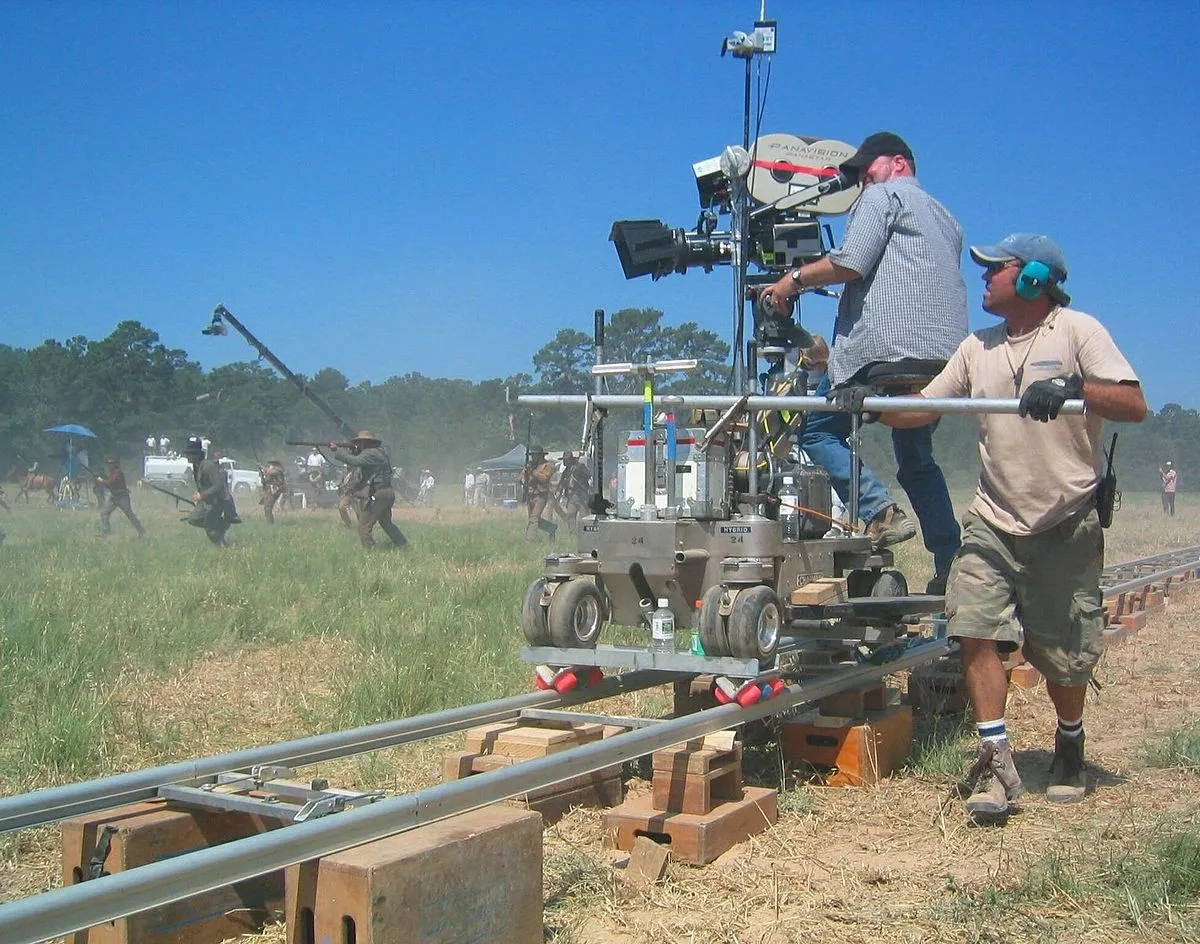
Image result for film set dolly track
Dolly Track in use. (Jason Hellerman 2019)
Some examples of common hazards that can occur on set are: tripping hazards, lifting hazards, and working from extreme heights. Another key risk that is common on film sets is moving camera shots where a cameraman is moving with the camera, during this process the cameraman could trip as they wouldn't be looking where they are going and could cause serious damage to themselves and the equipment, "When a camera operator or cast member is walking during a shot, make sure they are comfortable with their route and there is nothing that could cause problems (a camera operator who needs to walk backward for a shot should have an assistant to guide them and/or check their route)" (Moving Image Education 2019). An example of a way this could be avoided or at least on how to reduce the risk of this is through a dolly track, this track will allow the camera to move in these shots without risk of the cameraman hurting themselves, setting up a clear track that the camera can move on smoothly without bumping into anything/anyone.


Reference List
Moving Image Education ., (2019) Health and Safety [Online]
Available from:
https://movingimageeducation.org/create-films/production/the-production-department/health-and-safety

Jason Hellerman .,(2019) What is a dolly shot [Online]
Available from:
https://nofilmschool.com/what-is-a-dolly-shot